
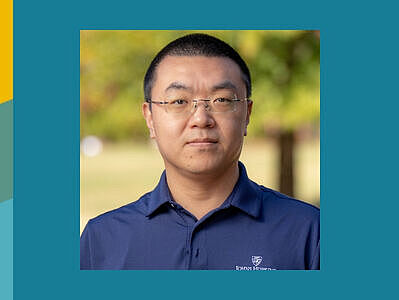
Wir laden herzlich zu unseren nächsten CASA Invited Talk am 28. April 2026 ein. Die CASA Invited Talks dauern in der Regel etwa eine Stunde und werden von einer offenen Diskussion mit dem Publikum gefolgt. Die Reihe zielt darauf ab, den Dialog zu fördern und neue Perspektiven in der Cybersicherheitsforschung zu eröffnen.
Wann: 28. April 2026, 14:00 Uhr
Wo: Open Space, MC (EG)
Online teilnehmen: Zoom
Abstract: As AI increasingly permeates our daily lives, it brings immense benefits but also introduces critical privacy challenges, such as data misuse, surveillance, and loss of control. In this talk, I will share my vision of an ecosystem where AI and privacy are not adversaries, but allies, and mutually reinforce and enrich one another. Rather than treating privacy as an obstacle, this ecosystem positions it as a foundational element of AI’s development, fostering a balanced environment that benefits both technology and society. I will introduce two fundamental relationships that drive this symbiotic ecosystem: 1) mutual benefit, wherein AI empowers users to understand and manage their data usage; 2) co-adaptation, wherein AI dynamically adapts to diverse privacy needs across contexts; The two relationships redefine AI as a respectful partner in our digital lives—one that supports human-centered values and upholds our autonomy and privacy. I will discuss challenges and open questions in achieving this vision.
Bio: Yaxing Yao is an assistant professor in the Department of Computer Science at Johns Hopkins University. His research lies at the intersection of human-computer interaction, privacy, and accessibility, focusing on exploring privacy issues in user interactions with computing systems and developing solutions to empower users to be aware and control their privacy. He has published in top human-computer interaction venues (e.g., CHI, CSCW, UIST) and privacy/security venues (e.g., the USENIX Security, SOUPS, PETS) and has received multiple paper awards, an NSF CAREER Award, a Google PSS Faculty Research Award, and two Meta Research Awards. Yao’s research is generously supported by the US NSF, Google, and Meta.
General note: In case of using gender-assigning attributes we include all those who consider themselves in this gender regardless of their own biological sex.
